
Photometry & Flicker
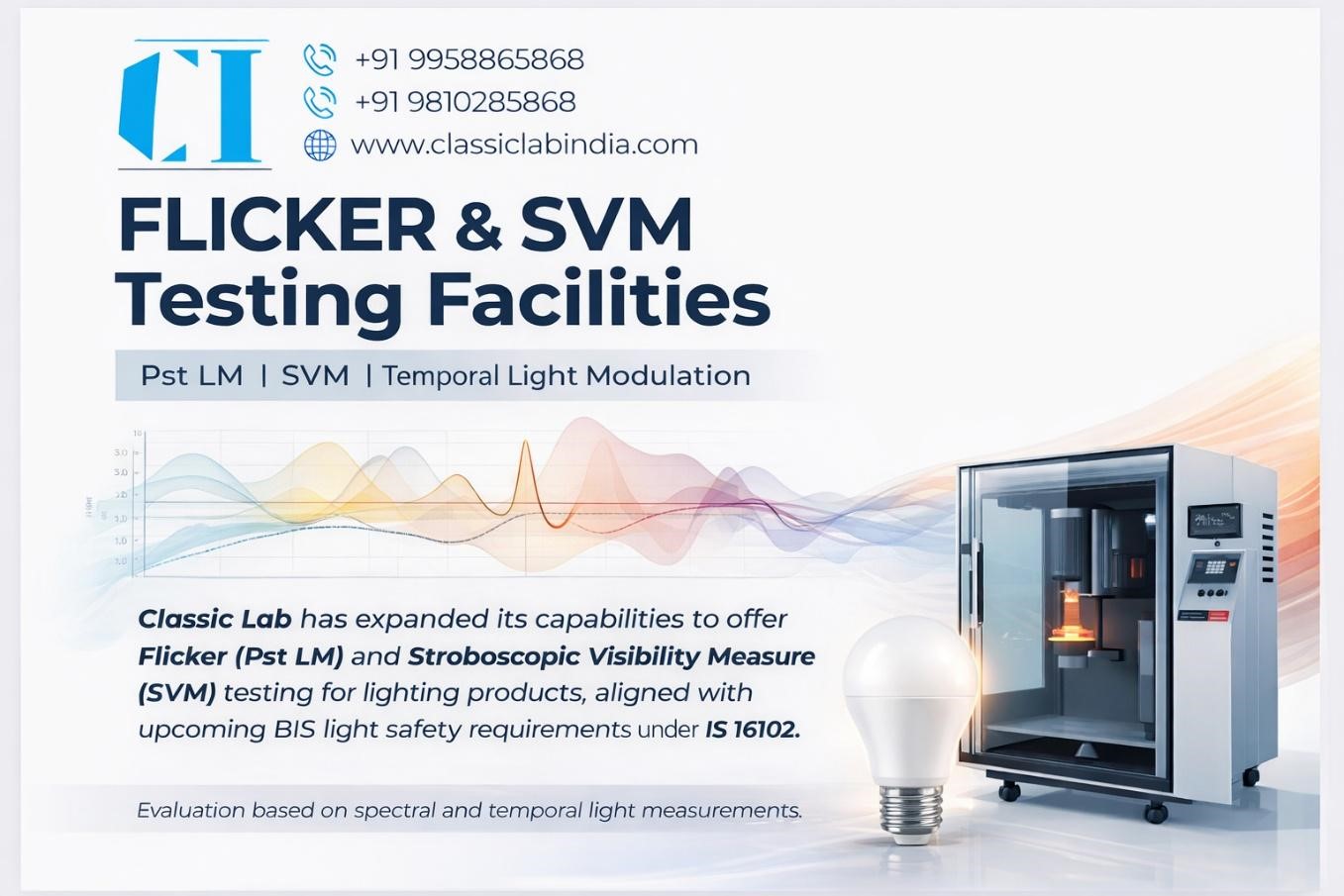
Flicker & SVM Testing for LED Lamps and Luminaires as per IS 16102 Part 2: 2026 - Complete Testing Facilities at Classic Labs, Delhi NCR
Introduction: Why Flicker in LEDs Is No Longer Just a Visual Annoyance
When we first switched from incandescent bulbs to LED lamps, most of us were sold on energy savings, long life, and environmental benefits. What was rarely discussed, however, was the invisible problem that followed: flicker. Unlike traditional bulbs that glow steadily due to thermal inertia, LEDs can switch on and off hundreds of times per second – and when that switching isn’t well controlled, the result is light flicker and stroboscopic effects that can cause headaches, eye strain, epileptic seizures in sensitive individuals, and even dangerous stroboscopic illusions in industrial environments.
Recognising this, the Bureau of Indian Standards has now introduced stringent flicker and stroboscopic limits in IS 16102 Part 2: 2026 – the latest revision of India’s performance standard for LED luminaires for general lighting services. Compliance is no longer optional for any responsible manufacturer, importer, or brand selling LED products in India.
At Classic Labs, we operate a state-of-the-art photometric and optical testing facility in Delhi NCR with full capability to evaluate LED lamps and luminaires for flicker, Stroboscopic Visibility Measure (SVM), and a comprehensive range of photometric, electrical, safety, and environmental parameters.
Understanding IS 16102 Part 2: 2026 - What Has Changed?
IS 16102 is India’s principal standard for LED luminaires used in general lighting. Part 2 deals specifically with performance requirements, covering photometric performance, electrical performance, colour quality, and critically – temporal light modulation (TLM), which encompasses both flicker and stroboscopic effects.
The 2026 edition aligns IS 16102 Part 2 more closely with international benchmarks including IEC 62717, ANSI/IEEE 1789, and CIE 232:2019, and tightens the acceptable thresholds for:
- Percent Flicker (Fluctuation Depth) – the relative amplitude of light output modulation
- Flicker Index – an energy-weighted measure of the waveform’s departure from steady output
- Stroboscopic Visibility Measure (SVM) – a perceptual model that quantifies how visible stroboscopic effects are to the human eye during motion
- Short-Term Flicker Severity (Pst LM) – derived from IEC 61000-3-3 methodology, applied to luminous flux modulation
- Frequency of modulation – since high-frequency modulation (>3000 Hz) is generally considered imperceptible and exempt from restrictions
In simple terms, IS 16102 Part 2: 2026 requires that LED luminaires not just look steady to the naked eye, but that they actually be steady in a way that is safe for prolonged occupational and domestic exposure.
What Is SVM (Stroboscopic Visibility Measure) and Why Does It Matter?
SVM – Stroboscopic Visibility Measure – is probably the most important new metric that many manufacturers are encountering for the first time. Unlike percent flicker, which measures how much the light varies in absolute terms, SVM measures how perceptible the stroboscopic effect is when objects move under the light source.
Think of a rotating fan under a flickering LED: if the fan blades appear to slow down, stop, or spin backwards, that is the stroboscopic effect in action. In industrial facilities, this can make rotating machinery appear stationary – a serious safety hazard. In offices and schools, it contributes to visual fatigue and discomfort without users even being consciously aware of the cause.
CIE 232:2019 defines SVM using a complex perceptual model based on human sensitivity to different temporal frequencies. An SVM value of 1.0 represents the threshold of perception – values below 1.0 are imperceptible to most observers. IS 16102 Part 2: 2026 sets clear upper limits, and products must demonstrate compliance through laboratory measurement.
Our Flicker Measurement Facility: Parameters We Can Test
Classic Labs uses a high-precision spectral flicker and photometry instrument with a fast temporal sampling capability. This instrument provides a complete picture of a lamp or luminaire’s optical and temporal behaviour in a single measurement, covering parameters required under IS 16102 Part 2: 2026 and related international standards.
Temporal Light Modulation (Flicker & Stroboscopic) Parameters
Parameter | Description | Standard Reference |
Flicker Frequency (Hz) | The dominant modulation frequency of the light output | ANSI/IEEE 1789 |
Fluctuation Depth / Percent Flicker (%) | Amplitude of light modulation as a percentage of peak output | IEC 62717 |
Blink Percent (%) | Percentage of the cycle during which luminance falls below 50% | IEC 62717 |
Blink Exponent | Shape factor of the modulation waveform | IEC 62717 |
SVM (Stroboscopic Visibility Measure) | Perceptual stroboscopic visibility metric; <1.0 = imperceptible | CIE 232:2019, IS 16102 Pt 2: 2026, IEC TR 63158 |
Pst LM (Short-Term Flicker Severity) | Psychophysical flicker discomfort metric | IEC TR 61547-1 |
MP (Modulation Percent) | Peak-to-peak modulation depth | ANSI/IEEE 1789 |
DP (Duty Percent) | Percentage of the cycle at full output | IEC 62717 |
Photometric and Colorimetric Parameters
Parameter | Description |
Illuminance E (lux / footcandles) | Measurement of light falling on a surface |
CCT – Correlated Colour Temperature (K) | Warmth or coolness of the white light |
Duv | Chromaticity deviation from the Planckian locus |
CIE 1931 x, y Chromaticity | Colour coordinates in the standard observer diagram |
CIE 1931 u, v / u’, v’ | Uniform chromaticity scale coordinates |
SDCM (MacAdam Ellipses) | Colour consistency; how close the lamp is to the target white point |
Ra (General CRI) | Colour Rendering Index – how accurately the lamp renders colours |
R1–R15 individual CRI values | Detailed colour fidelity for 15 test colour samples including R9 (saturated red) |
CQS (Colour Quality Scale) | Alternative colour quality metric |
TM-30 Rf (Colour Fidelity Index) | IES TM-30-20 fidelity index |
TM-30 Rg (Colour Gamut Index) | IES TM-30-20 gamut index |
GAI (Gamut Area Index) | Gamut area compared to a reference |
S/P Ratio (Scotopic/Photopic) | Mesopic vision sensitivity – relevant for roadway and dim-light applications |
Dominant Wavelength (nm) | Perceived primary colour wavelength |
Colour Purity (%) | Saturation relative to the spectrum locus |
Peak Wavelength (nm) | Wavelength of maximum spectral power |
Half-Width / FWHM (nm) | Spectral bandwidth of the dominant peak |
Centroid Wavelength (nm) | Energy-weighted centre of the spectrum |
Colour Ratio – R:G:B (%) | Relative contribution of red, green, and blue channels |
Irradiance Ee (mW/cm²) | Radiant flux per unit area |
Blue Light Hazard Ebh (mW/cm²) | Blue-weighted irradiance for photobiological safety |
Blue Light Hazard Risk Level | Risk category per IEC 62471 |
Bek (μW/lm) | Blue light content normalised to luminous flux |
TLCI-2012 | Television Lighting Consistency Index – for broadcast and studio lighting |
This comprehensive parameter set means a manufacturer can obtain not just IS 16102 Part 2 compliance data, but also TLCI scores for broadcast suitability, TM-30 data for premium specification sheets, and IEC 62471 photobiological safety classification – all from a single visit to our facility.
Complete Testing Capabilities for LED Lamps and Luminaires at Classic Labs
Flicker and SVM testing is just one part of the full certification and compliance journey for an LED product in India. Classic Labs offers an integrated, end-to-end testing facility so that manufacturers and importers can fulfil multiple testing requirements under one roof – saving time, reducing logistics costs, and ensuring consistent product evaluation.
- LM-79 Photometric Testing (Absolute Photometry)
LM-79 – the IES Approved Method for Electrical and Photometric Measurements of Solid-State Lighting Products – is the foundational photometric test for any LED product. We use a calibrated integrating sphere and a C-Type Goniophotometer setup to measure:
- Total Luminous Flux (lumens) – the actual light output of the complete luminaire
- Luminous Efficacy (lm/W) – energy efficiency
- Power Factor and Wattage
- Colour Rendering Index (Ra) and full spectral power distribution
- CCT and chromaticity coordinates
- Beam Angle
- Luminous Intensity (Cd)
LM-79 data is referenced in BIS standards, BEE star ratings, and many international tender specifications. It forms the backbone of IS 16102 Part 2 performance reporting.
- Flicker and SVM Testing (IS 16102 Part 2: 2026)
As described above, this is now a mandatory compliance parameter. Our facility provides complete TLM (Temporal Light Modulation) characterisation including SVM, Percent Flicker, Pst, and related parameters – all traceable to national reference standards.
- TLCI Testing (Television Lighting Consistency Index)
TLCI-2012 is the industry standard for evaluating how well a light source renders colours in broadcast, film, and studio environments. Broadcasters, production houses, and studio fixture manufacturers increasingly demand TLCI data. Our instrument computes TLCI scores directly as part of the spectral measurement, making it efficient to obtain broadcast-grade certification data alongside standard photometric testing.
- Harmonic Distortion Testing (IEC 61000-3-2 / IS 16102)
LED drivers frequently inject harmonic currents back into the power grid. Excessive harmonics cause overheating of neutral conductors, transformer failures, and interference with sensitive equipment. Testing per IEC 61000-3-2 (and IS 16102 Part 2 requirements) ensures your LED product’s power electronics comply with permissible total harmonic distortion (THD) and individual harmonic current limits. Our power analyser setup measures:
- Total Harmonic Distortion (THD-I)
- Individual harmonic currents (up to the 40th harmonic)
- Power Factor, Displacement Power Factor
- Inrush current characterisation
- Surge Immunity Testing (IEC 61000-4-5)
Power surges caused by lightning strikes, switching operations, and grid disturbances are a leading cause of premature LED driver failure in Indian conditions, where power quality varies significantly. Surge immunity testing per IEC 61000-4-5 subjects the product to defined voltage and current transients on both the differential and common mode, verifying that the driver can withstand real-world electrical stress without permanent damage.
- IP (Ingress Protection) Testing – IEC 60529
Whether your luminaire is rated IP20 for indoor use or IP67 for outdoor or industrial environments, we can verify the rating under controlled laboratory conditions. Our IP testing facility covers:
- Dust ingress protection (IP5X, IP6X) – using talcum powder test chambers
- Water ingress protection (IPX1 through IPX8) – drip tests, spray tests, immersion
- Combined dust and water (IP65, IP66, IP67, IP68)
IP ratings are mandatory for all outdoor LED luminaires and are increasingly specified for industrial and bathroom-rated indoor products.
- IK (Impact Protection) Testing – IEC 62262
IK ratings quantify a luminaire’s mechanical resistance to external impact – important for public area lighting, vandal-prone installations, and industrial environments. We test from IK01 (0.15 joules) through IK10 (20 joules) using a calibrated pendulum hammer or spring-operated striker, reporting the maximum impact energy the product enclosure can withstand without failure.
- Vibration Testing – IEC 60068-2-6 / IS 9000
Luminaires installed on bridges, industrial machinery, transportation vehicles, or even buildings in seismically active zones are subject to continuous vibration. Vibration testing on our electrodynamic shaker verifies structural integrity and electrical continuity under:
- Sinusoidal sweep vibration
- Fixed frequency dwell
- Random vibration (where applicable)
- Defined frequency ranges and acceleration levels per relevant IS or IEC test conditions
- Mechanical Shock Testing – IEC 60068-2-27 / IS 9000
Shock testing simulates rough handling during transportation and installation, as well as sudden mechanical impacts during service. Our shock testing capability covers:
- Half-sine, sawtooth, and trapezoidal pulse shapes
- Peak acceleration up to specified g-levels
- Multiple orientations (6 faces + 2 edges as required)
This is particularly relevant for portable luminaires, street light heads, and products exported to markets with demanding logistics conditions.
- Salt Spray / Salt Mist Testing – IEC 60068-2-11 / IS 9000
Corrosion resistance is critical for outdoor luminaires, especially in coastal areas, industrial zones with chemical exposure, or any environment with elevated humidity and airborne chlorides. Our salt spray chamber subjects luminaire housings, hardware, and electrical connections to a continuous mist of 5% sodium chloride solution at controlled temperature, replicating years of environmental exposure in a matter of hours or days. Parameters evaluated include:
- Duration of exposure (24h, 48h, 96h, 240h, 480h, 720h)
- Visible corrosion on metallic parts
- Impact on sealing (combined with IP evaluation)
- Finish degradation on painted or powder-coated surfaces
- Safety Testing – IS and IEC Standards
Safety testing is perhaps the most critical and most regulated category. Classic Labs is a BIS-approved laboratory for several product categories and conducts safety evaluation as per:
- IS 16102 Part 1 (Safety requirements for LED luminaires)
- IS 10322 series (Fixed general purpose luminaires)
- IEC 60598 series (Luminaires – safety requirements)
- IS 16103 / IEC 62031 (LED modules)
Safety tests include:
- Dielectric strength (Hi-pot) and insulation resistance
- Leakage current and touch current
- Protective earth continuity
- Temperature rise measurement on windings, contacts, and accessible surfaces
- Ball pressure test on thermoplastic components
- Glow wire / needle flame tests on non-metallic parts
- Mechanical strength tests on enclosures and lamp holders
- Creepage and clearance distances on PCBs and wiring
- Ingress protection verification (coordinated with IP testing)
Our safety testing capability covers both type-approval testing for BIS registration and routine batch-level testing for quality assurance.
Why Test at Classic Labs?
NABL Accreditation and BIS Approval
One-Stop Testing for LED Products
One of the most common pain points for LED manufacturers and importers is coordinating tests across multiple laboratories – photometry here, safety there, environmental somewhere else – each with its own scheduling, costs, and report formats. Classic Labs is designed to be a single-window solution. From LM-79 photometry and flicker testing through safety evaluation, harmonics, surge, IP, IK, vibration, shock, and salt spray – we can handle the complete test programme for your LED product under one accredited roof.
Experienced Technical Team
Our technical staff has deep domain experience in photometric testing, electrical safety, and environmental testing for lamps and luminaires. We understand the nuances of Indian standards, the linkage between IS and corresponding IEC standards, and the practical interpretation of test results – which means you get not just numbers, but actionable technical guidance.
Location Advantage: Delhi NCR
Located in Noida, part of Delhi NCR, Classic Labs is centrally accessible to manufacturers based in Delhi, Haryana, Uttar Pradesh, Rajasthan, and Himachal Pradesh—all of which host significant LED manufacturing clusters. Our location also makes it easy for importers who clear goods through Delhi to route samples for testing without unnecessary transit time.
Frequently Asked Questions
Q: Is SVM testing mandatory for all LED products under IS 16102 Part 2: 2026?
SVM testing applies to LED luminaires used for general lighting in indoor environments. IS 16102 Part 2: 2026 specifies applicable categories and limits. We recommend getting in touch with our technical team to confirm applicability for your specific product type.
Q: Can flicker testing be done independently, or does it need to accompany LM-79 testing?
Flicker testing can be done as a standalone evaluation.
Q: What is the typical turnaround time for LED luminaire testing at Classic Labs?
Turnaround time depends on the scope of testing. For a standard photometry + flicker evaluation, results are typically available within 3–5 working days. Safety and environmental test programmes (which involve extended conditioning and exposure durations) have longer lead times. Contact us for a project-specific timeline.
Q: Do you accept samples from overseas manufacturers?
Yes, we regularly work with overseas manufacturers and their Indian representatives or importers.
Q: What information should I have ready when contacting Classic Labs for LED testing?
It is helpful to provide: the product name and model number, intended application (indoor/outdoor, commercial/domestic), target Indian/international standards for compliance, wattage and voltage rating, and whether the product is a lamp, module, or complete luminaire. This helps us prepare an accurate test scope and quotation quickly.
Get in Touch
If you are a manufacturer, importer, brand, or procurement professional looking for reliable, NABL-accredited LED testing services in Delhi NCR – for flicker, SVM, LM-79, TLCI, harmonics, surge, IP, IK, vibration, shock, salt spray, or complete safety evaluation as per IS and IEC standards – Classic Labs is ready to support your compliance journey.
NABL Accredited | BIS Approved | ISO/IEC 17025 | TEC | QAI
[Contact us for a test scope discussion and quotation]
Keywords: Flicker testing LED India, SVM testing IS 16102 Part 2 2026, stroboscopic visibility measure LED luminaire, NABL accredited LED testing laboratory Delhi, NABL accredited LED testing laboratory Noida, LM-79 testing India, TLCI testing laboratory, harmonic distortion LED testing IEC 61000-3-2, surge immunity LED IEC 61000-4-5, IP testing luminaires Delhi NCR, IK testing IEC 62262, salt spray testing LED, LED safety testing BIS, IS 16102 Part 2 compliance testing, percent flicker testing LED, Pst flicker severity measurement, photobiological safety IEC 62471, CRI TM-30 testing India, LED testing lab Delhi NCR
